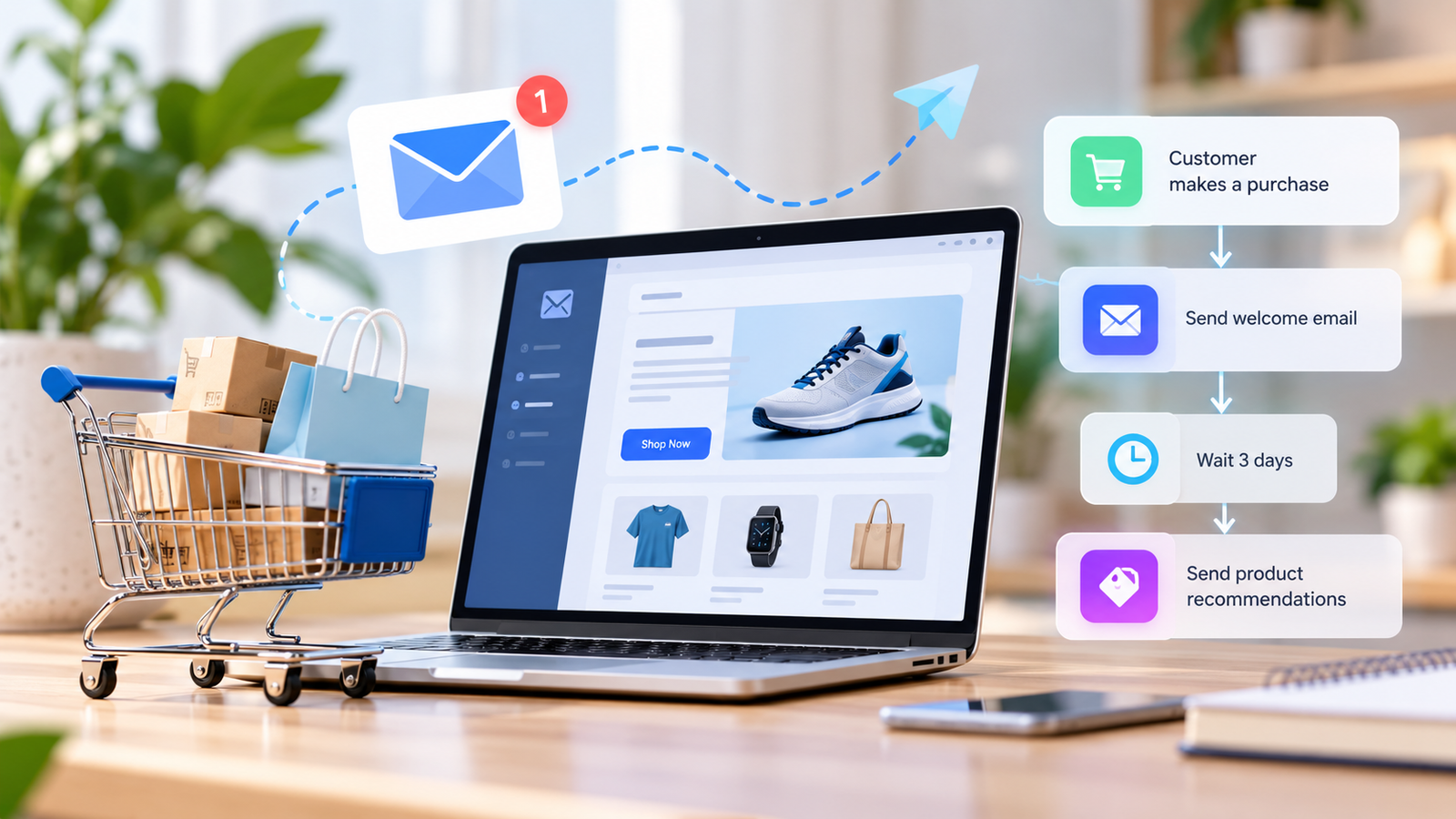
There isn't one best email marketing platform for ecommerce. The right choice depends on the store you run: the ecommerce platform underneath it, the size of the team, how complicated the automation has become, how fast the list and send volume will grow, and how much rebuilding you're willing to take on if you move.
A Shopify store with one marketer and three core flows has a different problem from a DTC brand with a dedicated lifecycle team. Both differ again from a WooCommerce store that first needs its order and cart data to reach the email platform cleanly. A single ranked list of six tools would flatten those differences, so this guide asks a different question about Klaviyo, Omnisend, ActiveCampaign, Mailchimp, Drip and Brevo. When does each one become the better fit, and when does it stop being one?
Nine variables tend to change the answer:
- Ecommerce platform (Shopify, WooCommerce or another)
- Store size and contact growth
- Team size, and who will actually build and maintain the flows
- Whether your automation complexity comes from customer behavior or from workflow architecture
- Segmentation requirements
- Email only, or email plus SMS
- Sending frequency
- Budget structure
- Migration cost, if you already use another platform
Pricing and plan details change often, so treat the cost discussion below as a framework for checking live numbers rather than a price list.
Quick Decision Map
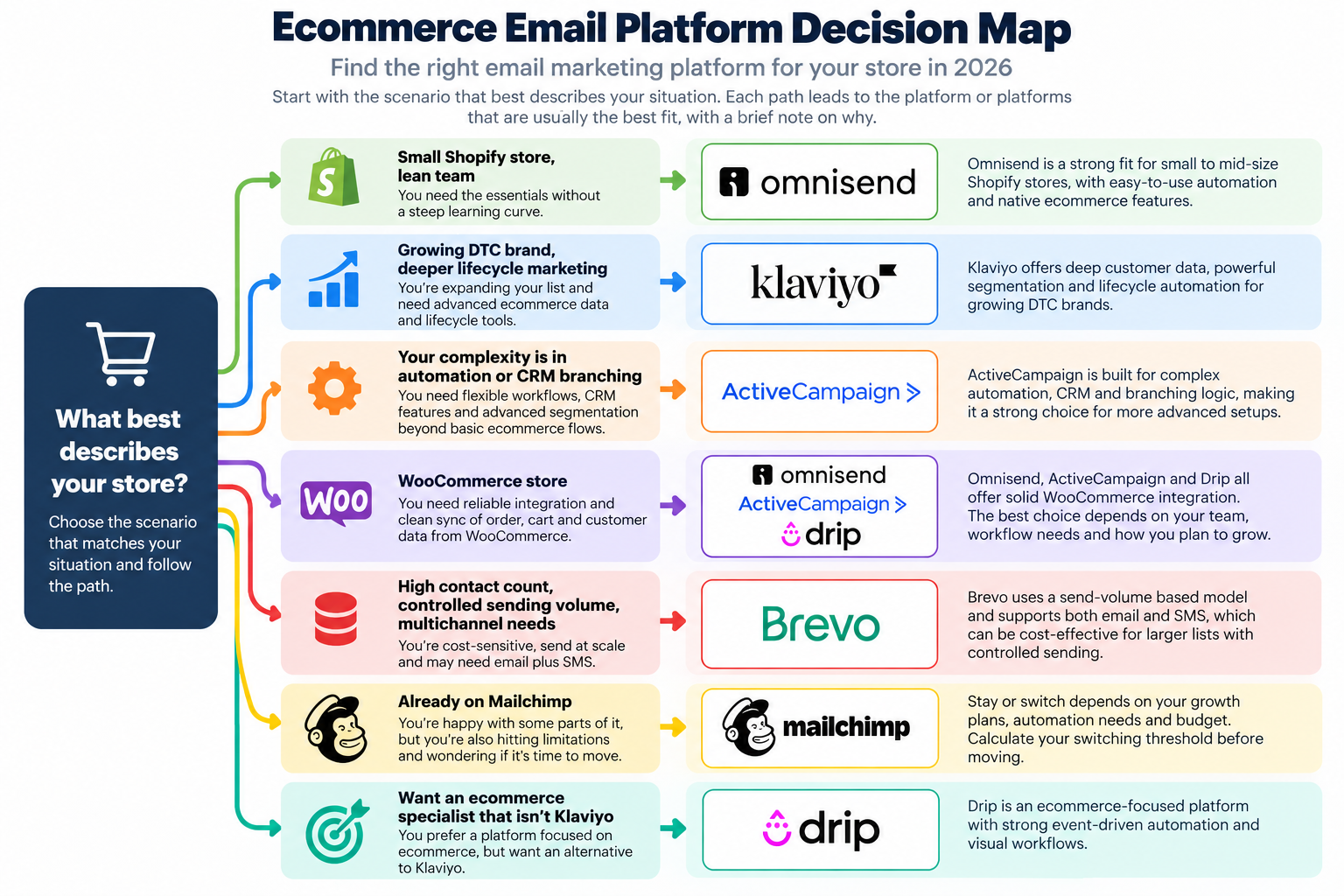
| If this describes you | Start by looking at |
|---|---|
| Small Shopify store, lean team | Omnisend |
| Growing DTC brand, deeper lifecycle marketing | Klaviyo |
| Your complexity is in automation or CRM branching | ActiveCampaign |
| WooCommerce store | Compare Omnisend, ActiveCampaign and Drip |
| High contact count, controlled sending volume, multichannel needs | Investigate Brevo |
| Already on Mailchimp | Calculate your switching threshold before moving |
| Want an ecommerce specialist that isn't Klaviyo | Consider Drip |
Treat the map as a starting point rather than a verdict. The rest of the guide explains why each route exists and where it breaks down.
How the Six Platforms Compare
The table compares the variables that actually change a recommendation, not feature counts. Read the last two columns first: what drives the bill, and where each platform tends to run out of road.
| Platform | Strongest fit | Ecommerce data depth | Automation orientation | Team complexity | Pricing driver | Primary limitation |
|---|---|---|---|---|---|---|
| Klaviyo | Growing DTC and lifecycle-led teams | Deep behavioral and profile layer; billing and segmentation are profile-centric | Customer-behavior and lifecycle flows | Higher; value depends on whether the team uses the extra depth | Active profiles and email send allowance; advanced analytics can be an add-on | Greater depth can bring greater cost and operating complexity |
| Omnisend | Small to mid-size store-centric teams, especially Shopify | Native store data with order, product and customer sync; behavior and segment conditions | Store-centric ecommerce workflows with conditional and A/B splits | Lower operating complexity | Billable contacts and plan tier, with send allowances and SMS rules varying by plan | Ceiling sits in data-model and segment timing and in highly individualized lifecycle logic, not in basic branching |
| ActiveCampaign | Teams with complex workflow or CRM logic | Deep Data integrations for Shopify, WooCommerce, BigCommerce, Square and Magento | Workflow, branching and CRM architecture | Higher setup and maintenance burden | Dynamic contact-based pricing and plan tier; advanced automation may require higher tiers | Configurability adds setup and maintenance work |
| Mailchimp | Existing users with moderate needs | Connected-store purchase and behavior data; site tracking can capture product views, add-to-cart and purchases | Customer journeys plus behavior- and segment-driven automation | Familiar to many teams; advanced segmentation requires the Standard plan or higher | Contact tier, plan tier, and send allowance or SMS add-ons | Convenience versus growing automation, pricing and lifecycle needs |
| Drip | Teams wanting deeper ecommerce automation under a different operating model from Klaviyo | Native Shopify, WooCommerce and BigCommerce data; order, cart and product events; segmentation | Behavior-based ecommerce workflows | Moderate; setup is still required, but the workflow model is ecommerce-oriented | Active people and email volume; SMS billed separately where available | Pricing, integration breadth and SMS availability and feature limits |
| Brevo | Cost-structure and multichannel-led teams | Ecommerce events via plugin or API, plus website tracking for product and cart behavior | CRM, transactional, and event-driven automation across email, SMS, push and WhatsApp | Ecommerce behavior may need more tracking and integration work | Primarily send volume and plan tier rather than a simple contact-only model | Behavioral automation can require more integration architecture |
Scenario Analysis: Where Each Platform Fits
Scenario A: A small Shopify store with a lean team
If your store needs a welcome flow, cart recovery and a handful of post-purchase emails, you probably don't need the deepest lifecycle platform yet. The more useful question is whether you will really use advanced lifecycle features, or whether you mainly need the core ecommerce workflows running reliably with minimal overhead.
For that second profile, Omnisend is the natural starting point. It is built around store-centric ecommerce automation with comparatively low operating complexity, which suits a team that wants meaningful automation without assembling a full lifecycle stack on day one.
The alternatives depend on circumstances:
- Mailchimp makes sense if the store already runs there and the existing workflows are sufficient (see Scenario F).
- Brevo enters the picture if cost structure or multichannel needs are driving the decision (see Scenario E).
- Klaviyo fits a small store only where advanced needs already exist. Where they don't, public user feedback points to the risk of a small team ending up with more platform than it uses.
Scenario B: A growing DTC brand
Once segmentation, customer behavior analysis and lifecycle flows start to carry real revenue weight, deeper ecommerce data begins to pay for itself. Klaviyo is the primary candidate here, with Omnisend and Drip as secondary options.
The catch is in the word "pay." The extra depth produces value only when the team builds on it. If your flows are still mostly welcome, cart and post-purchase, a more modest platform may keep working longer than you'd expect. If your team is regularly working around data or segmentation limits, that is the signal that a deeper platform deserves a serious look.
Omnisend stays in the conversation for teams that want to hold operational complexity down as they grow. Drip is worth a look if you want deeper ecommerce automation under a different operating model, provided its pricing, integration and SMS constraints work for you.
Scenario C: An advanced lifecycle or automation team
At this level the decision usually comes down to Klaviyo versus ActiveCampaign, with Drip as a supporting alternative. Neither is simply the one with "better automation." They handle different kinds of complexity.
Klaviyo's complexity comes from ecommerce customer behavior: what customers buy, browse and do, and how you segment and message on that basis. ActiveCampaign's complexity comes from workflow, automation and CRM architecture: branching logic, multi-stage processes, and customer journeys that extend beyond the order.
A DTC brand whose hard problem is "which customers should get which message, based on what they've done" is facing the first kind. A business whose hard problem is "how do we coordinate a multi-stage process across sales, service and marketing" is facing the second. Many stores sit clearly in one camp. If yours straddles both, test the specific workflows that matter most before committing.
Scenario D: A WooCommerce store
Shopify recommendations don't transfer directly to WooCommerce. The platform underneath changes how order data, product data and cart events reach the email tool, and that determines what the tool can do for you.
Omnisend, ActiveCampaign and Drip are the core candidates, with Brevo and Klaviyo as conditional options. Official documentation shows meaningfully different WooCommerce implementations:
- Omnisend uses a dedicated WooCommerce plugin. It syncs historical contacts, products and orders, then keeps core store data current through the WooCommerce REST API and webhooks. The same plugin powers on-site tracking and abandoned-cart events, which makes this a fairly direct, store-centric setup.
- ActiveCampaign uses a one-way WooCommerce Deep Data sync. It can import historical orders, abandoned carts, customers and products and use them in automations, segments and goals. The sync direction and the automation architecture lean toward CRM and workflow logic.
- Drip syncs customer lists, historical orders and products, shows order and browsing activity on customer profiles, and includes WooCommerce-specific cart abandonment, abandoned-browse, post-purchase and welcome workflows.
- Klaviyo offers a WooCommerce extension with real-time data sync and website activity tracking, including started-checkout and viewed-product behavior for abandonment and lifecycle flows.
- Brevo can ingest standard ecommerce events, such as cart updates and completed orders, through compatible plugins and use them in segmentation and automations. More specialized custom behavior may need tracker or API work.
- Mailchimp has a WooCommerce plugin that syncs customer and order data and supports ecommerce automations, product recommendations, purchase-based segmentation and abandoned-cart messaging.
None of these is universally best. If you want the most store-native path, compare how much setup each plugin needs and what data arrives automatically. If you need complex cross-functional workflow logic, ActiveCampaign becomes more relevant. If behavior-led ecommerce automation is the priority, Drip, Omnisend and Klaviyo all deserve workflow-by-workflow testing against your own store.
Scenario E: A cost-sensitive growing store
Starting prices mislead most when budget is the constraint. Brevo and Omnisend are the core candidates here, with Drip as a secondary option where its ecommerce automation depth justifies the price.
Which one is cheapest depends on how you send:
- A contact-heavy, lower-frequency sender has a large list but sends relatively rarely. Pricing tied mainly to send volume tends to look more favorable than pricing tied to contact or profile counts, though this needs checking platform by platform.
- A frequent ecommerce sender runs many campaigns and active flows, often with automation features that sit on higher plan tiers. For this profile, plan tier and add-ons can matter more than the base price.
Brevo is interesting here for reasons beyond a low headline price: a pricing structure built primarily around send volume and plan tier, and a multichannel, CRM-oriented scope. Whether it actually saves money depends on whether that model matches how you send. The pricing section below shows how to check.
Scenario F: An existing Mailchimp user
If you're already using Mailchimp, the first question isn't whether another platform has more features. It's whether the differences are large enough to justify rebuilding your workflows. The stay-versus-switch section later in this guide works through that threshold.
Platform Deep Dives
The scenarios show where each platform enters the decision. These sections look at what each one asks of you in return.
Klaviyo
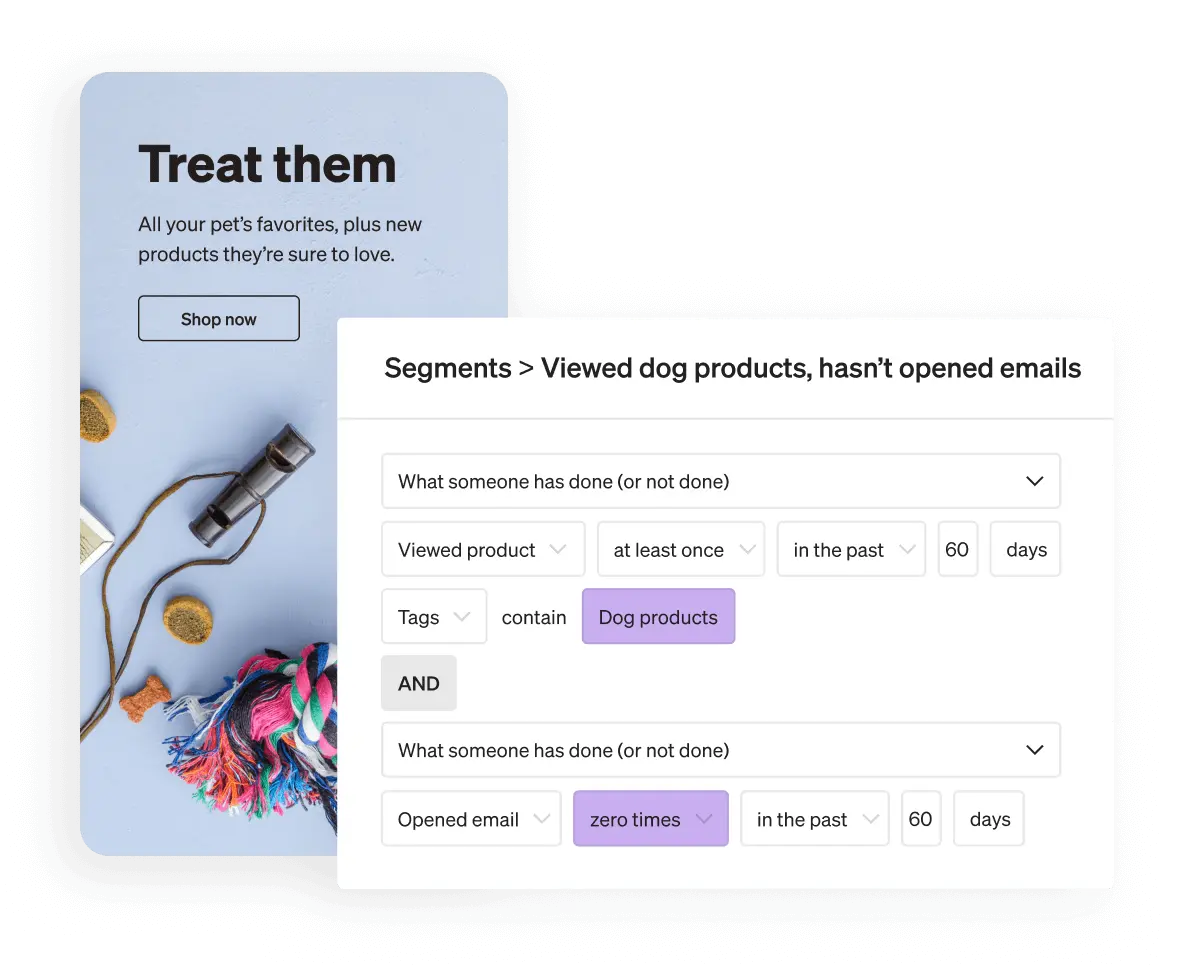
Klaviyo gives you more room to build around customer behavior, but that room only matters if your team is going to use it. That is the central trade-off. For a growing DTC brand or a mature lifecycle team, deeper ecommerce data and strong segmentation are the capabilities that change outcomes. Recent G2 reviews repeatedly praise its segmentation and flow builder, especially from stores that are actually running behavior-based lifecycle programs.
The cost side deserves equal attention. A recurring theme in public user feedback is concern about price growth as lists expand, and Klaviyo's own billing documentation helps explain why. The base email plan must cover your active profiles, send allowance is tied to the profile tier, and Marketing Analytics is a separate paid product. The result is that list growth raises your cost even when your team's automation sophistication hasn't changed. For a small team running a few standard flows, the question isn't whether Klaviyo is capable. It's whether the extra depth is used often enough to justify that cost structure.
That is also where it stops fitting: a store with a handful of standard flows, or a team without the time to work with behavioral segmentation, is paying for depth it can't yet turn into results. Small teams focused on core welcome, cart and post-purchase flows, and stores where cost growth is the main constraint, should be cautious. If advanced needs emerge later, Klaviyo remains the platform to evaluate.
Omnisend
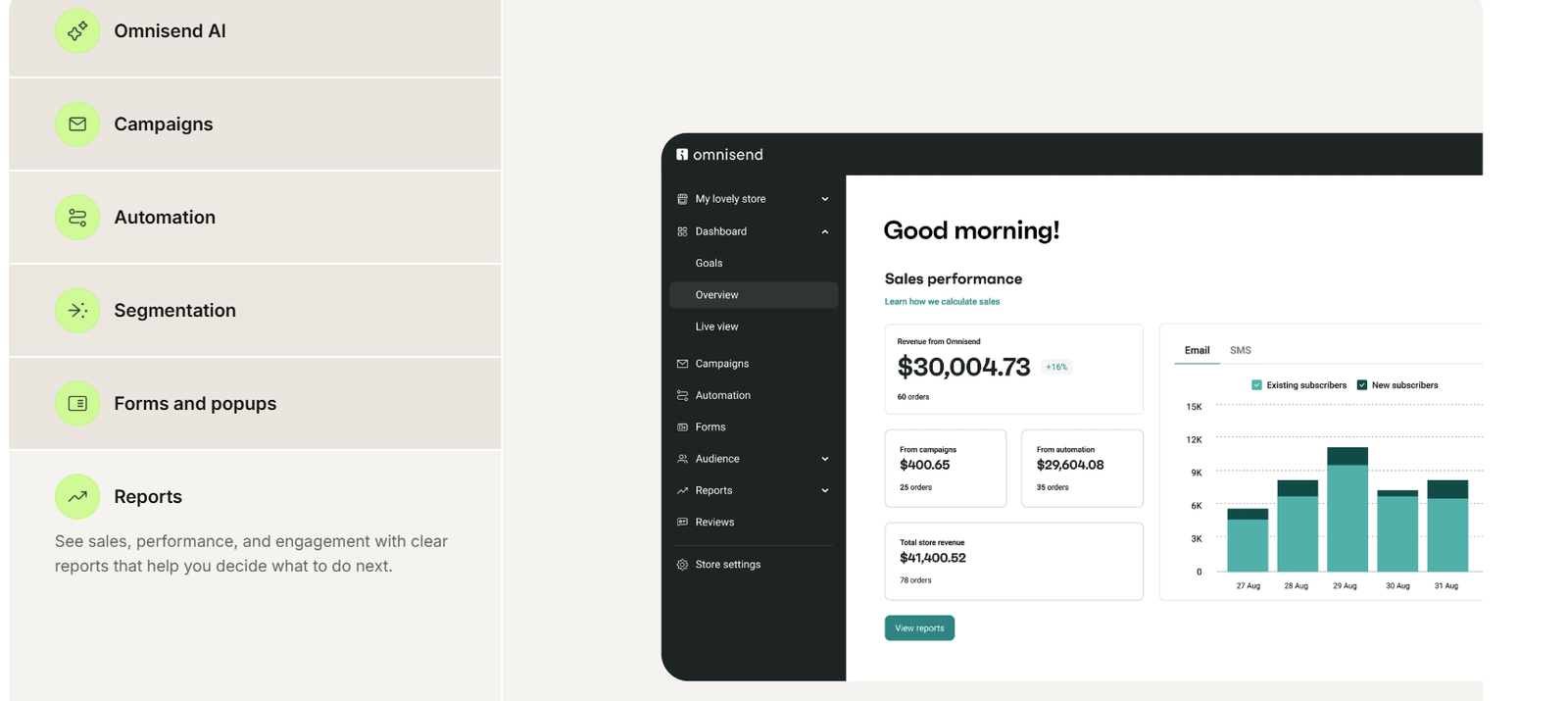
Omnisend suits a store that wants real ecommerce automation without the operating load of a highly complex lifecycle setup. Recent G2 feedback repeatedly describes it as straightforward to set up and intuitive for campaign and automation work, which supports its role for lean ecommerce teams.
It would be inaccurate to describe its limit as "basic automation." Omnisend supports conditional splits, nested paths, A/B-test splits, exit conditions and a wide library of ecommerce workflows. The more defensible boundary is about data and segmentation. Complex segment membership can introduce refresh-timing considerations, and the filters you can use still depend on the data your ecommerce platform sends into Omnisend. Some G2 reviewers also note missing or limited advanced features or integrations, so confirm that anything you rely on is covered.
You'll feel that ceiling if your lifecycle strategy depends on highly individualized logic, or if your team keeps bumping into segmentation limits. At that point Klaviyo (behavioral depth) or ActiveCampaign (workflow architecture) becomes worth comparing. Teams already hitting those ceilings, or needing CRM-style workflow architecture, shouldn't start here.
ActiveCampaign
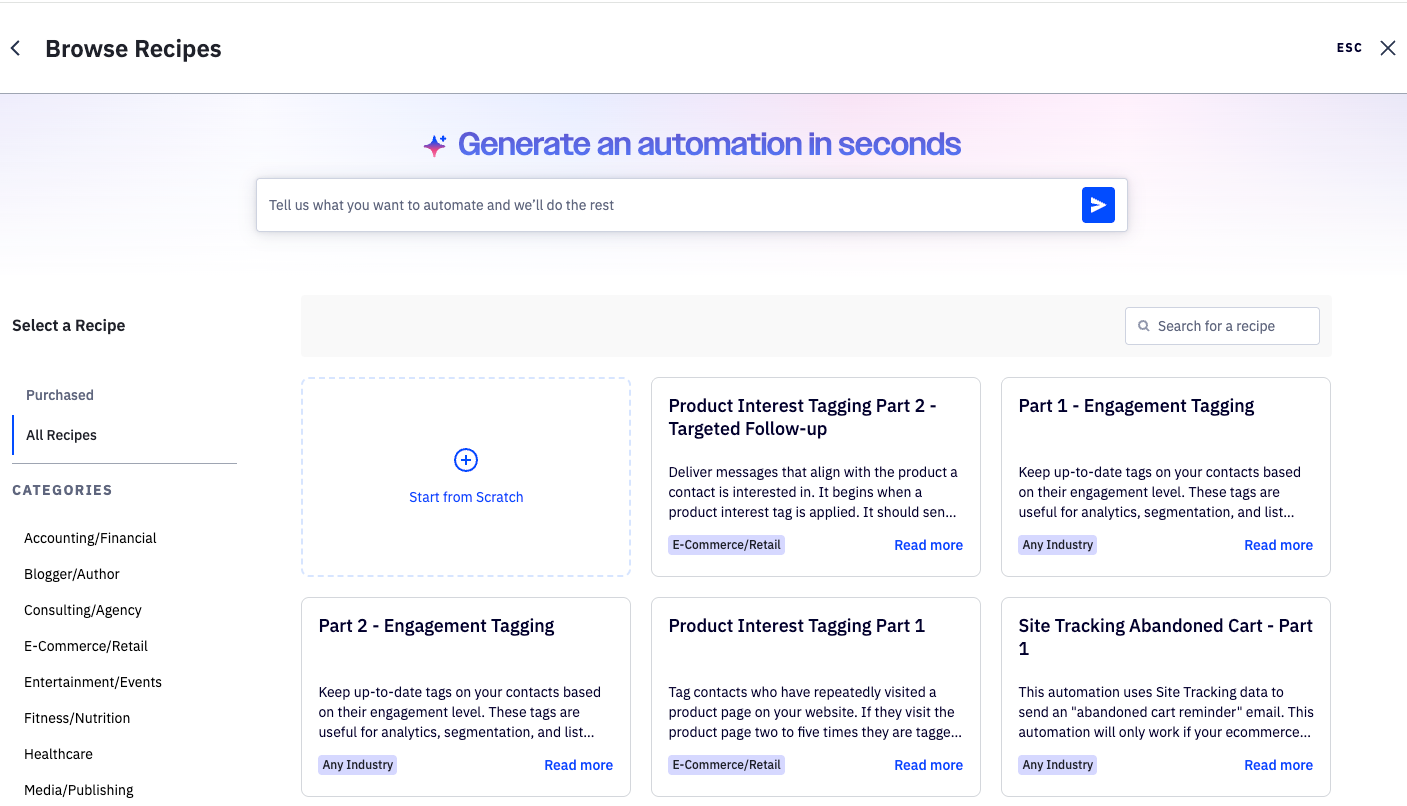
ActiveCampaign matters when the hard part of your marketing is no longer sending emails but coordinating complex workflows. If your complexity comes from branching, CRM logic and multi-stage customer processes rather than ecommerce-native functions alone, it addresses that architecture directly. User feedback consistently centers on automation flexibility, segmentation and workflow power. That fits the product's role here: the value shows up when the problem is coordinating logic across steps, conditions and customer states, not switching on standard ecommerce flows.
The price of that power is setup and maintenance. Public user feedback commonly describes a learning-curve trade-off once automations become more advanced. On the ecommerce side, official documentation confirms Deep Data integrations for Shopify, WooCommerce, BigCommerce, Square and Magento, and for WooCommerce that includes syncing historical orders, abandoned carts, customers and products into segmentation and automation logic.
If your needs are mainly store-centric flows (cart, welcome, post-purchase), that workflow depth can mean added configuration with little added value. Lean teams without a need for CRM-style branching, and stores that want to run on native ecommerce data with the least setup, are better served elsewhere.
Mailchimp
If you're already using Mailchimp, switching is not automatically an upgrade. That is why Mailchimp works as the benchmark in this guide: any move has to beat what you already have, net of the cost of leaving.
Part of the case for staying is practical. A team that already knows the editor, templates and journey builder avoids the retraining and rebuild cost of a migration, and that counts for more than a comparison chart suggests. Part of it is capability. Mailchimp shouldn't be treated as a basic ecommerce tool by default. Its Site Tracking Pixel can capture page views, product views, add-to-cart actions and purchases on connected Shopify, Wix and WooCommerce stores, and the Standard plan and above include advanced segmentation with nested AND/OR logic.
Pricing and automation depth are the usual reasons people leave, and they are real. The question is whether those capabilities remain sufficient at the complexity and contact tier you now need. When lifecycle flows grow more intricate or behavioral segmentation needs deepen, the limits become operational rather than theoretical. For a store starting fresh that already knows it needs deep behavioral segmentation or complex lifecycle logic, Mailchimp is unlikely to be the first choice.
Drip
Drip is easy to file as "another Klaviyo alternative," and that misses why a team would choose it. It is an ecommerce automation specialist with a different operating model, aimed at teams that want deeper ecommerce automation. Recent G2 feedback highlights its visual workflow builder and its ability to turn product and customer events into marketing actions without heavy developer involvement.
The trade-offs are pricing, ecosystem and SMS. Drip's current pricing is driven by the number of active people and monthly email volume. The pricing page lists 90+ integrations, so check your own stack against that list. SMS needs special caution in a current comparison. Drip's billing documentation states that SMS is unavailable to new users, so a store that depends on SMS should verify current availability before treating Drip as a multichannel option.
If SMS is central to your plan, start there: Drip's current billing documentation says SMS is unavailable to new users. That may rule it out regardless of its email strengths. The same goes if your key integrations sit outside its supported ecosystem. And if the price isn't justified by the ecommerce automation depth you'll actually use, a lower-cost option will likely serve you better.
Brevo
Brevo becomes interesting for a different reason than the others: its pricing structure and its multichannel and CRM scope. Calling it simply the cheapest option misses the point. Recent G2 feedback frequently highlights the convenience of handling several marketing activities in one place, and the appeal of a send-volume-oriented pricing model for some small and mid-size teams.
The trade-off is tracking and integration architecture. Brevo's Shopify PushOwl app can install the tracker and sync Shopify data automatically, and compatible ecommerce plugins can send standard cart and order events into Brevo. More specialized custom behavior may still require tracker or API implementation, which adds operational work compared with platforms where more ecommerce behavior is native by default. G2 reviewers also mention that integrations and setup can be a friction point for some users.
So the savings are real only if you have the capacity to do that setup. If your lifecycle depends on rich ecommerce behavioral triggers and your team can't invest in the tracking work, the apparent savings may be offset by effort. Teams that want ecommerce behavior wired in with minimal integration effort should look at the ecommerce-native options first.
Stay vs. Switch: The Mailchimp Question
Migration has real costs. Moving platforms means rebuilding flows, templates, segmentation, data connections and team habits, so the question is when the benefit grows large enough to justify that work.
Staying makes sense when your existing workflows are sufficient, your team already understands the system, ecommerce automation needs remain moderate, and the cost of switching outweighs the incremental gains of a new platform.
Switching starts to make sense when lifecycle flows are becoming more complex, you need deeper behavioral segmentation, pricing growth is becoming a problem, SMS or broader ecommerce workflow expansion is on the roadmap, or platform limitations are turning operationally significant.
To calculate your own threshold, list the flows, templates and segments you would have to rebuild, estimate the hours, and compare that against a specific gain you expect. That gain might be revenue from better segmentation, lower cost at your list size, or a capability you can't get today. If you can't name a concrete gain, staying is usually the better call. If you can name several, the destination depends on which need is driving the move: behavioral depth (Klaviyo), store-centric simplicity (Omnisend), workflow architecture (ActiveCampaign), or cost structure (Brevo).
Pricing and Growth Cost
Starting prices rarely predict what you'll pay as the store grows. A more useful comparison asks what drives the bill on each platform. The drivers differ more than the headline numbers do:
| Platform | What mainly drives cost |
|---|---|
| Klaviyo | Active profiles and email send allowance; advanced analytics can be an add-on |
| Omnisend | Billable contacts and plan tier, with send allowances and SMS rules varying by plan |
| ActiveCampaign | Dynamic contact-based pricing and plan tier; advanced automation may require higher tiers |
| Mailchimp | Contact tier, plan tier, and send allowance or SMS add-ons |
| Drip | Active people and email volume; SMS billed separately where available |
| Brevo | Primarily send volume and plan tier rather than a simple contact-only model |
Plan tier matters as much as list size. If the automation you need sits on a higher tier, the headline starting price isn't the price you'll pay, so compare the plan that actually supports your workflows.
When you run your own numbers, check four list sizes: 1,000, 5,000, 10,000 and 30,000 contacts. At the smaller sizes, compare the plan that supports your required ecommerce automation, along with the monthly send allowance and how SMS and add-ons are treated. By 10,000, re-run each vendor's live calculator and note whether cost is being driven mainly by contacts or profiles, or by send volume. At 30,000, several vendors use dynamic calculators or tailored pricing, so rely on live quotes rather than estimates.
Keep your sending profile in view throughout. A contact-heavy, lower-frequency sender and a frequent ecommerce sender will often find different platforms more economical, even on the same list size.
How to Choose
A short sequence works better than a feature checklist:
- Start with your ecommerce platform. Shopify and WooCommerce don't hand data to an email platform in the same way, so check integration details for yours before anything else.
- Be honest about your team. Count who will build and maintain the flows. Capability nobody has time to use doesn't help.
- Name your automation problem. If it's customer behavior, you're in Klaviyo territory. If it's workflow and CRM architecture, look at ActiveCampaign.
- Test the segmentation you actually need. If your requirements are individualized or data-heavy, check data-model limits before committing.
- Model cost at your list size and sending frequency. Use the contact tiers above and identify what drives cost on each platform.
- If you use Mailchimp, calculate the switching threshold. Weigh rebuild effort against a specific, named gain.
- Shortlist two platforms and test the workflows that matter most. Klaviyo and Omnisend currently offer free plans capped at 250 contacts/profiles and 500 monthly email sends; ActiveCampaign offers a 14-day trial with Professional-plan features but limited sending and one user; Mailchimp offers a 14-day trial of Standard or Essentials for eligible accounts; Drip offers a 14-day trial with no credit card; and Brevo's Free plan has no time limit, with 300 daily email sends and marketing automation limited to 2,000 contacts. Verify these conditions again at publication because trial terms can change.
Best Newsletter Platforms in 2026
Conclusion
No single platform is the best email marketing software for ecommerce. The answer moves with your situation.
A small Shopify store with a lean team should start with Omnisend and check whether Mailchimp or Brevo fits its cost and workflow needs better. A growing DTC brand reaches the point where Klaviyo becomes relevant once behavioral segmentation and lifecycle depth start driving results, with Omnisend and Drip as alternatives. For advanced lifecycle teams, the choice is Klaviyo for behavior-driven complexity or ActiveCampaign for workflow and CRM complexity. WooCommerce stores should compare Omnisend, ActiveCampaign and Drip on how each handles their order, product and cart data. Cost-sensitive stores should look at Brevo and Omnisend and model pricing against their real sending profile rather than the starting price. And if you're already on Mailchimp, don't switch until the gain clearly outweighs the rebuild.
The right platform is the one whose strengths match the problem you actually have, at a cost and complexity your team can sustain.
Comments
One response to “Best Email Marketing Software for Ecommerce in 2026: Which Platform Fits Your Store?”
[…] Skip it if you are not an ecommerce business, or your needs are basic enough that a lighter tool covers them. For wider context, see our comparison of Best Email Marketing Software for Ecommerce in 2026. […]